



πŸŽ‰ National Days Library Books β€’ Writing β€’ Family Fun Explore all days β†’

Wright Brothers Day

Learning Adventure

Celebrate the first powered flight and discover what it takes to get an airplane off the ground.

Curated by Laela
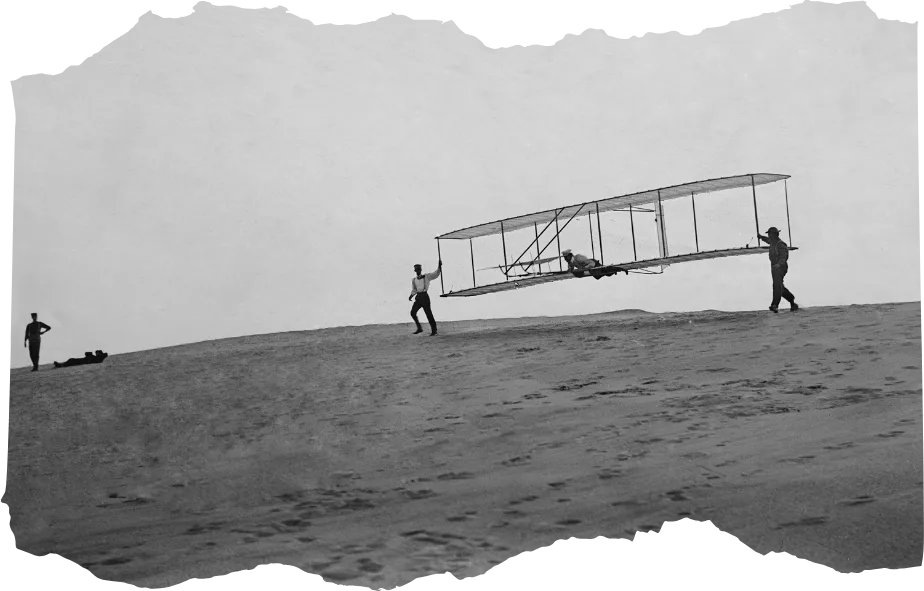
Wright Brothers' glider iwth a single vertical rudder before its flight, Oct. 10, 1902. Orville lies prone in glider as Wilbur and Dan Tate hold the wing tips at left and right. Kitty Hawk, North Carolina.
Ready for Takeoff!
πŸ“Œ Quick FactsπŸ“… December 17πŸ‡ΊπŸ‡Έ Celebrated in the US ✈️ First flight: 12 seconds, 120 feet
❀️ Why We Celebrate

On December 17, 1903, Orville and Wilbur Wright made four successful powered flights near Kitty Hawk, North Carolina, proving that a pilot could control a heavier-than-air flying machine in flight. Their success came after years of gliders, wind-tunnel experiments, crashes, adjustments, and repeated testing. Wright Brothers Day celebrates that breakthrough and the curiosity, persistence, and engineering that helped launch the age of aviation.

πŸ’‘ Did You Know?

Wilbur actually won a coin toss for the first chance to fly, but his December 14 attempt ended in a crash. After repairs, it was Orville's turn on December 17, and he made the first successful flight.

✨ Adventure Highlights
✏️ Pilot’s Log πŸ—ΊοΈ Kitty Hawk Geography πŸ›©οΈ Aircraft Controls πŸ§ͺ Wind Tunnel Testing

ο»Ώ
1

Read

πŸ“–

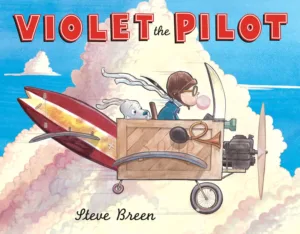
Violet the Pilot

by Steve Breen

Violet isn’t satisfied simply imagining flying machines. She builds them, tests them, improves them, and climbs aboard. Her wonderfully unusual inventions make this a playful companion to the Wright brothers’ own years of experimentation and a perfect invitation to think like an aircraft designer.

As you read, look closely at Violet’s contraptions. What features seem inspired by real airplanes, helicopters, bicycles, or other machines?
πŸ“– View Book
2

Write

✏️
You've just climbed into an experimental airplane that has never flown before.Write a short pilot's test-flight log describing what happens from takeoff to landing. Include at least three aviation words and report one thing the aircraft does especially well and one thing the engineers should improve before its next flight.

Need ideas?

Pilots and engineers use precise words to describe what an aircraft is doing. You might use runway, cockpit, altitude, propeller, rudder, pitch, roll, yaw, lift, or drag.

What does the aircraft do when you leave the ground? Does it climb smoothly, pull to one side, shake at high speed, or handle perfectly? A good test pilot notices details that can help the engineers make the next flight better.

3

Play

πŸŽ‰
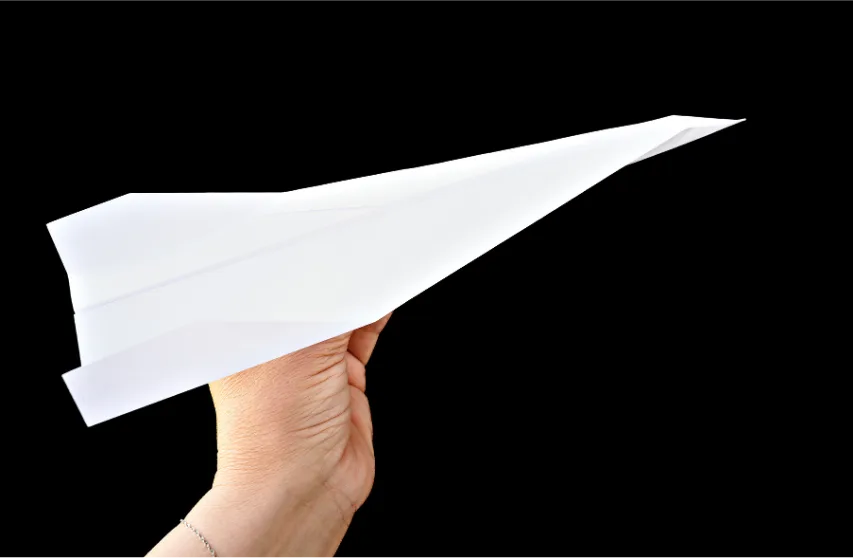
hand holding white paper airplane on black background

Paper Airplane Flight Test

Build a simple paper airplane, but don’t stop after the first flight.

Choose one thing to change, such as the wing shape, nose weight, wingtip angle, or paper size. Fly the original and modified versions from the same starting point several times and compare what happens.

You could measure:

  • πŸ“ Distance
  • ⏱️ Time aloft
  • 🎯 Accuracy
  • πŸ›¬ Smoothest landing

Before changing anything else, decide which design performed better.

πŸ’œ Resources We Love Β· Some links are affiliate links that support DUYW at no extra cost to you.
🌎 Adventure Trails

Every adventure has another path to follow. Choose a trail and see where your curiosity leads!

Engineering Trail: How Do You Steer an Airplane?

Getting an aircraft into the air wasn’t enough. The Wright brothers needed a way for the pilot to control pitch, roll, and yaw. Their Flyer used wing warping to help control roll, while modern airplanes usually use movable surfaces called ailerons.

Wonder Challenge:
Find a diagram of a modern airplane’s controls. Which parts control pitch, roll, and yaw?

Geography Trail: Why Kitty Hawk?

The Wright brothers traveled from Dayton, Ohio, to North Carolina looking for three things: wind, sand, and isolation. The Outer Banks offered steady winds, wide sandy areas, and plenty of open space for flight experiments.

Wonder Challenge:
Find Kitty Hawk and Dayton on a map. How far did the Wright brothers have to travel just to test their flying machines?

Science Trail: Inside the Wind Tunnel

When their glider results didn’t match existing calculations, Wilbur and Orville built a small wind tunnel and tested about 200 wing shapes to collect better information about lift and drag.

Wonder Challenge:
Compare several airplane wing shapes. What differences do you notice, and how might those differences affect the air moving around them?

Would you rather...

OR

Print & Plan

Printable Lesson Snapshot

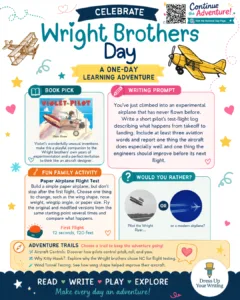
Keep today’s book pick, writing prompt, family activity, and discussion ideas together in one colorful overview.

View & Print This Adventure Perfect for homeschool or classroom planning.

πŸ›©οΈ Share Your Spark!

Today’s conversation: What’s the best air or space museum your family has visited, or which one is on your wish list?

πŸ’¬οΈ
Family Friendly

Every comment is reviewed before it's published.

β™₯

Be kind. Be helpful.
Be inspiring! πŸ’›

Add Your Spark

Your comment will appear after it has been reviewed.

πŸ›©οΈ
Laela DUYW Team August 28, 2026

One of our favorite aviation trips was the Steven F. Udvar-Hazy Center in Chantilly, Virginia. The museum itself is incredibly cool and educational, and since it’s near a major commercial airport, we also spent some time watching planes come in and take off. And the IMAX screen was HUGE! ✈️

Keep Exploring