

πŸŽ‰ National Days Library Books β€’ Writing β€’ Family Fun Explore all days β†’

National

Thesaurus Day

Learning Adventure

Celebrate words, word choices, and the satisfying search for exactly the right one.

Curated by Laela
a maroon background with the word Thesaurus
Find the Right Word!
πŸ“Œ Quick FactsπŸ“… January 18πŸ‡ΊπŸ‡Έ Celebrated in the US πŸ“š Roget was born January 18, 1779.
❀️ Why We Celebrate

National Thesaurus Day celebrates one of a writer’s handiest tools: a collection of words connected by meaning. The day honors Peter Mark Roget, whose love of organizing words eventually became his famous thesaurus. Today, we’ll go word hunting, explore stronger word choices, and discover why synonyms don’t always mean exactly the same thing.

πŸ’‘ Did You Know?

πŸ’° The word "thesaurus" can mean a treasury or storehouse, making a thesaurus quite literally a treasure house of words.

✨ Adventure Highlights
✏️ Shades of Meaning πŸ“š Peter Mark Roget πŸ’° Word Origins πŸ”¬ Roget the Scientist

ο»Ώ
1

Read

πŸ“–

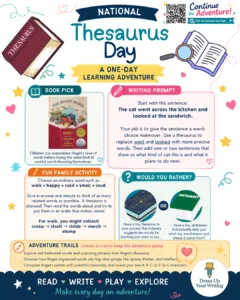
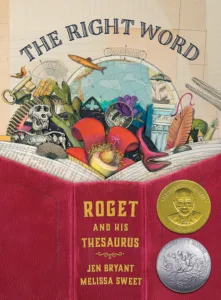
The Right Word: Roget and His Thesaurus

by Jen Bryant, illustrated by Melissa Sweet

Peter Mark Roget loved lists, patterns, and finding exactly the right word to express an idea. Jen Bryant tells the story of how that fascination eventually grew into Roget’s thesaurus, while Melissa Sweet fills the pages with detailed mixed-media illustrations, lists, labels, and bits of language that make the book itself feel like a collection waiting to be explored.

Children can experience Roget’s love of words before trying the same kind of careful word choosing themselves.

The book won the 2015 Robert F. Sibert Medal and received a Caldecott Honor.

πŸ“– View Book
2

Write

✏️
Find the right word!

A thesaurus can give you several words that mean almost the same thing, but each one creates a slightly different picture.

Start with this sentence:

The cat went across the kitchen and looked at the sandwich.

Your job is to give the sentence a word-choice makeover.

Use a thesaurus to replace went and looked with more precise words. Then add one or two sentences that show us what kind of cat this is and what it plans to do next.

Maybe the cat crept, stalked, darted, or sauntered across the kitchen.

Maybe it stared, glanced, peeked, or gazed at the sandwich.

Choose carefully. Your words should tell us something about the cat before you ever explain it.

Need a Little Inspiration?

Imagine the difference between a cat that creeps toward the sandwich and one that struts toward it. One sounds sneaky. The other sounds remarkably confident! Try several possible words aloud and notice how each one changes the picture in your mind.

A thesaurus can suggest possibilities, but you still have to decide which word says exactly what you mean.

3

Play

πŸŽ‰
word ladder game with synonyms

Synonym Showdown

Choose an ordinary word such as:

walk β€’ happy β€’ cold β€’ small β€’ loud β€’ look

Give everyone one minute to think of as many related words as possible. A thesaurus is allowed!

Then read the words aloud and put them in an order that makes sense.

For walk, you might collect:

creep β†’ stroll β†’ stride β†’ march β†’ stomp

There may not be one perfect order, and that’s part of the fun. Talk about what each word makes you picture.

Bonus round: Pick two of the words and act them out. Can everyone guess which one you chose?

πŸ’œ Resources We Love Β· Some links are affiliate links that support DUYW at no extra cost to you.
🌎 Adventure Trails

Every adventure has another path to follow. Choose a trail and see where your curiosity leads!

Language Trail: Words from Another Time

Open an older edition of Roget’s Thesaurus and you may find expressions that sound wonderfully strange today. Under cold, for example, Roget includes comparisons such as “cold as a frog,” while the section on credulity includes the phrase “think the moon is made of green cheese.” Browse the Project Gutenberg edition and see what else you discover.

Wonder Challenge:
Find one word or phrase you have never heard before. Can you figure out what it meant from the words around it?

History Trail: Roget’s Word Map

Roget did not originally arrange his thesaurus like a modern alphabetical dictionary. He organized words by ideas, placing them into enormous categories such as Space, Matter, Intellect, and Affections, then dividing those into smaller ideas such as existence, relation, size, movement, and emotion.

Wonder Challenge:
Browse Roget’s categories. Which heading surprises you most, and where would you look if you wanted words about something like fear, distance, or friendship?

Science Trail: Sort It Out

Roget organized words into groups of related ideas. Scientists do something similar with living things through taxonomy, a system that sorts life into groups such as kingdom, phylum, class, order, family, genus, and species. One way to remember the order is with a mnemonic, a silly sentence in which each word begins with the same letters as the groups.

Wonder Challenge:
Try this one: King Phillip Called Out For Green Spaghetti. Now invent your own K-P-C-O-F-G-S mnemonic. The sillier and more memorable, the better!

Would you rather...

OR

Print & Plan

Printable Lesson Snapshot

Keep today’s book pick, writing prompt, family activity, and discussion ideas together in one colorful overview.

View & Print This Adventure Perfect for homeschool or classroom planning.

Keep Exploring