πŸŽ‰ National Days Library Books β€’ Writing β€’ Family Fun Explore all days β†’

Gingerbread House Day

Learning Adventure

Build something sweet and think like an architect!

Curated by Laela
National Gingerbread House Day
Build It Sweet!
πŸ“Œ Quick FactsπŸ“… December 12πŸ‡ΊπŸ‡Έ Celebrated in the US
❀️ Why We Celebrate

Gingerbread House Day celebrates one of the sweetest forms of architecture imaginable: tiny cottages built from spiced cookies, icing, and candy. Today we’ll become gingerbread architects, investigate buildings made to stand, and follow the scent of spices across centuries and continents.

πŸ’‘ Did You Know?

The fairy-tale candy house in Hansel and Gretel helped make gingerbread houses especially popular in Germany during the 1800s.

✨ Adventure Highlights
✏️ Worldbuilding & Description 🏠 Architecture 🌍 Gingerbread Around the World 🧭 Ancient Spice Trade

ο»Ώ
1

Read

πŸ“–

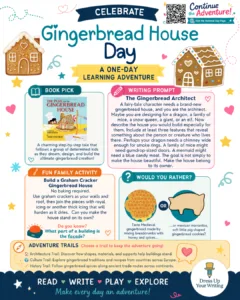
The Plan for the Gingerbread House: A STEM Engineering Story

by Darcy Pattinson

A charming step-by-step tale that follows a group of determined kids as they dream, design, and build the ultimate gingerbread creation. It’s perfect inspiration for today’s gingerbread architecture adventure, whether you read it before or after building your own sweet masterpiece.

πŸ“– View Book
2

Write

✏️
A fairy-tale character needs a brand-new gingerbread house, and you are the architect.

The Gingerbread Architect

You have just received your most unusual architectural commission yet.

Choose your client. Maybe you are designing for a dragon, a family of mice, a snow queen, a giant, an elf, or a character of your own invention.

Now describe the house you would build especially for them.

Include at least three features that reveal something about the person or creature who lives there.

Perhaps your dragon needs a chimney wide enough for smoke rings. A family of mice might need gumdrop-sized doors. A mermaid might need a blue candy moat.

The goal is not simply to make the house beautiful.

Make the house belong to its owner.

Need a Little Inspiration?

Architects think about both form and function: what a building looks like and how it needs to work.

Who lives in your house? What do they need? Choose precise details that help your reader picture the finished house.

3

Play

πŸŽ‰
build a gingerbread house together

Build a Graham Cracker Gingerbread House

No baking required.

Use graham crackers as your walls and roof, then join the pieces with royal icing or another thick icing that will harden as it dries.

Add whatever decorations you already have available:

  • 🍬 Candies
  • πŸ₯¨ Pretzels
  • πŸ₯£ Cereal
  • πŸͺ Cookies
  • πŸ₯₯ Coconut β€œsnow”
  • 🍫 Chocolate chips
  • 🧁 Sprinkles

But before decorating, put on your architect hats. Can you make the house stand on its own?

Notice what happens when walls are crooked, the roof is too heavy, or the icing has not hardened enough. Try changing the design if something collapses.

πŸ’œ Resources We Love Β· Some links are affiliate links that support DUYW at no extra cost to you.
🌎 Adventure Trails πŸ“Œ Open the World Explorer Map

Every adventure has another path to follow. Choose a trail and see where your curiosity leads!

Architecture Trail: Why Buildings Stand

Architects think about much more than how a building looks. Walls, roofs, shapes, materials, and the way weight is supported all help a structure stay standing.

Wonder Challenge:
Look at three buildings near you. What shapes do you notice in the roofs, windows, or supports. Do those shapes repeat?

Culture Trail: Gingerbread Around the World

Gingerbread developed into many regional traditions across Europe. Explore German Lebkuchen, Polish pierniki, Swedish pepparkakor, French pain d’épices, and other spiced treats that do not all look or taste alike.

Wonder Challenge:
Look at the different recipes and photos. Which looks least like the gingerbread you expected? If you have time, choose the one that interests you most and try making it together.

History Trail: Follow the Spice Route

Gingerbread can contain a whole world of spices, and each one begins as a very different part of a plant. Centuries ago, many of these spices traveled enormous distances along trade routes connecting Asia, the Middle East, Africa, and Europe.

🫚 Ginger may look like a root, but it is actually a rhizome, or underground stem. It is warm and peppery.

🌿 Cinnamon comes from the inner bark of trees! You can follow this spice even further in our National Cinnamon Day Learning Adventure. Cinnamon is sweet and woody.

🌸 Cloves are dried, unopened flower buds from an evergreen tree. They are bold and fragrant.

🌱 Cardamom comes from aromatic seeds tucked inside small pods. It belongs to the same plant family as ginger, even though the two spices look and taste very different. Cardamom can be floral and citrusy.

⭐ Anise and star anise have remarkably similar licorice-like flavors, but they come from two completely different plants. Anise comes from an herb in the parsley family, while star anise grows on an evergreen tree native to southern China and northern Vietnam.

Wonder Challenge: Find the original growing regions of ginger, cinnamon, cloves, cardamom, anise, and star anise on a map. Which spice do you think had the most remarkable journey before reaching a gingerbread baker in northern Europe?

Would you rather...

OR

Print & Plan

Printable Lesson Snapshot

Keep today’s book pick, writing prompt, family activity, and discussion ideas together in one colorful overview.

View & Print This Adventure Perfect for homeschool or classroom planning.

Keep Exploring