



๐ŸŽ‰ National Days Library Books โ€ข Writing โ€ข Family Fun Explore all days โ†’

International

Monkey Day

Learning Adventure

Celebrate clever monkeys, wild sounds, and the surprising ways primates communicate.

Curated by Laela
International Monkey Day
Go Bananas!
๐Ÿ“Œ Quick Facts๐Ÿ“… December 14๐ŸŒ Celebrated Worldwide Started in 2000
โค๏ธ Why We Celebrate

Monkey Day began as a wonderfully silly idea between college art students and has since grown into a worldwide celebration of monkeys and other primates. Today is a chance to discover just how varied monkeys really are, while learning more about the habitats and behaviors that make each species unique.

๐Ÿ’ก Did You Know?

Monkey alarm calls can carry surprisingly specific messages! Vervet monkeys use different calls for threats such as eagles, leopards, and pythons, and the troop reacts differently to each warning.

โœจ Adventure Highlights
โœ๏ธ Onomatopoeia ๐Ÿ”Š Monkey Communication ๐ŸŒŽ Old World & New World ๐Ÿซ Rainforest Connections

๏ปฟ
1

Read

๐Ÿ“–

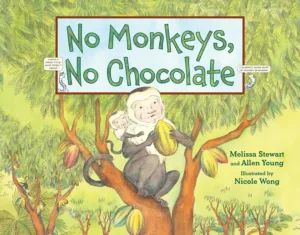
No Monkeys, No Chocolate

by Melissa Stewart and Allen Young

Chocolate might seem like a strange place to begin a monkey adventure, which is exactly what makes this book such a great choice. What do monkeys have to do with chocolate? The answer leads us into the tropical rainforest, where cacao trees depend on a complicated web of living things. Monkeys, insects, fungi, and other organisms all play a part in helping the trees grow, reproduce, and survive.

The book makes those connections especially engaging by pairing clear nonfiction explanations with humorous commentary from two bookworms in the illustrations. It is a great reminder that even something as familiar as a chocolate bar can have a much bigger story behind it.
๐Ÿ“– View Book
2

Write

โœ๏ธ
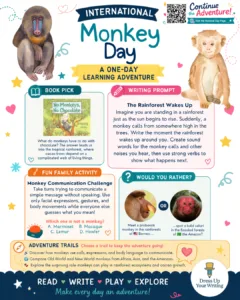
Imagine you are standing in a rainforest just as the sun begins to rise.Suddenly, a monkey calls from somewhere high in the trees.Write the moment the rainforest wakes up around you. Create sound words for the monkey calls and other noises you hear, then use strong verbs to show what happens next.

Explore Onomatopoeia

Onomatopoeia is a word that sounds like the noise it describes, such as buzz, crash, or splash.

What might a monkey call sound like to you? Maybe it hoots, whoops, chatters, shrieks, or makes a sound you have to invent yourself. Then listen to the rest of your imaginary rainforest. Are leaves rustling? Wings flapping? Rain dripping? Branches cracking?

You might begin:

OOH-OOH-OOOH! The call rolled through the trees…

3

Play

๐ŸŽ‰
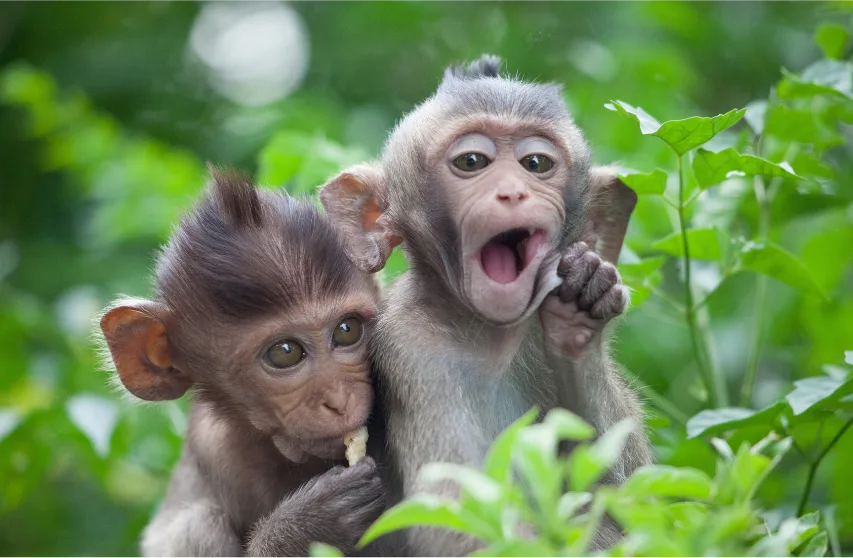
two young monkeys eating green leaves

Monkey Communication Challenge

Take turns trying to communicate a simple message without speaking. Use only facial expressions, gestures, and body movements while everyone else guesses what you mean.

Try messages such as:

  • Come here.
  • Watch out!
  • I found food!
  • Leave me alone.
  • Let’s go.
  • I’m excited.

Then talk about which signals were easiest to understand.

Monkeys also communicate through combinations of vocalizations, facial expressions, posture, grooming, and body movements.

๐Ÿ’œ Resources We Love ยท Some links are affiliate links that support DUYW at no extra cost to you.
๐ŸŒŽ Adventure Trails ๐Ÿ“Œ Open the World Explorer Map

Every adventure has another path to follow. Choose a trail and see where your curiosity leads!

Biology Trail: Monkey Messages

Monkeys communicate with much more than noise. Different species use calls, facial expressions, body movements, grooming, and other signals to share information. Vervet monkeys can even use different alarm calls for different kinds of danger.

Wonder Challenge:
Watch or listen to two different monkey species communicating. What differences do you notice in their sounds or movements?

Geography Trail: Two Monkey Worlds

Monkeys are often grouped as Old World monkeys, found naturally in Africa and Asia, and New World monkeys, found in Central and South America. Old World monkeys include unusual species such as ๐Ÿ‡จ๐Ÿ‡ณ China’s thick-furred golden snub-nosed monkey, ๐Ÿ‡ฎ๐Ÿ‡ณ India’s silver-maned lion-tailed macaque, and the brilliantly colored mandrill of Central Africa. New World monkeys include tiny species such as the boldly mustached emperor tamarin of the Amazon Basin and long-limbed spider monkeys, found from ๐Ÿ‡ฒ๐Ÿ‡ฝ Mexico through Central America and into South America, which use prehensile tails to grip branches as they move through the forest.

Wonder Challenge:
Choose one Old World monkey and one New World monkey to look up. What is the most surprising difference you notice between them?

Ecology Trail: No Monkeys, No Chocolate?

Cacao grows in tropical rainforest ecosystems, especially in regions of Central and South America such as ๐Ÿ‡ฒ๐Ÿ‡ฝ Mexico, ๐Ÿ‡จ๐Ÿ‡ท Costa Rica, ๐Ÿ‡ช๐Ÿ‡จ Ecuador, and ๐Ÿ‡ง๐Ÿ‡ท Brazil. Some monkeys eat the sweet pulp inside cacao pods and help disperse the seeds, making them one surprising part of the rainforest web behind chocolate.

Wonder Challenge:
Follow the journey from cacao seed to chocolate bar. How many different living things can you find that help somewhere along the way?

Would you rather...

OR

Print & Plan

Printable Lesson Snapshot

Keep todayโ€™s book pick, writing prompt, family activity, and discussion ideas together in one colorful overview.

View & Print This Adventure Perfect for homeschool or classroom planning.

Keep Exploring