


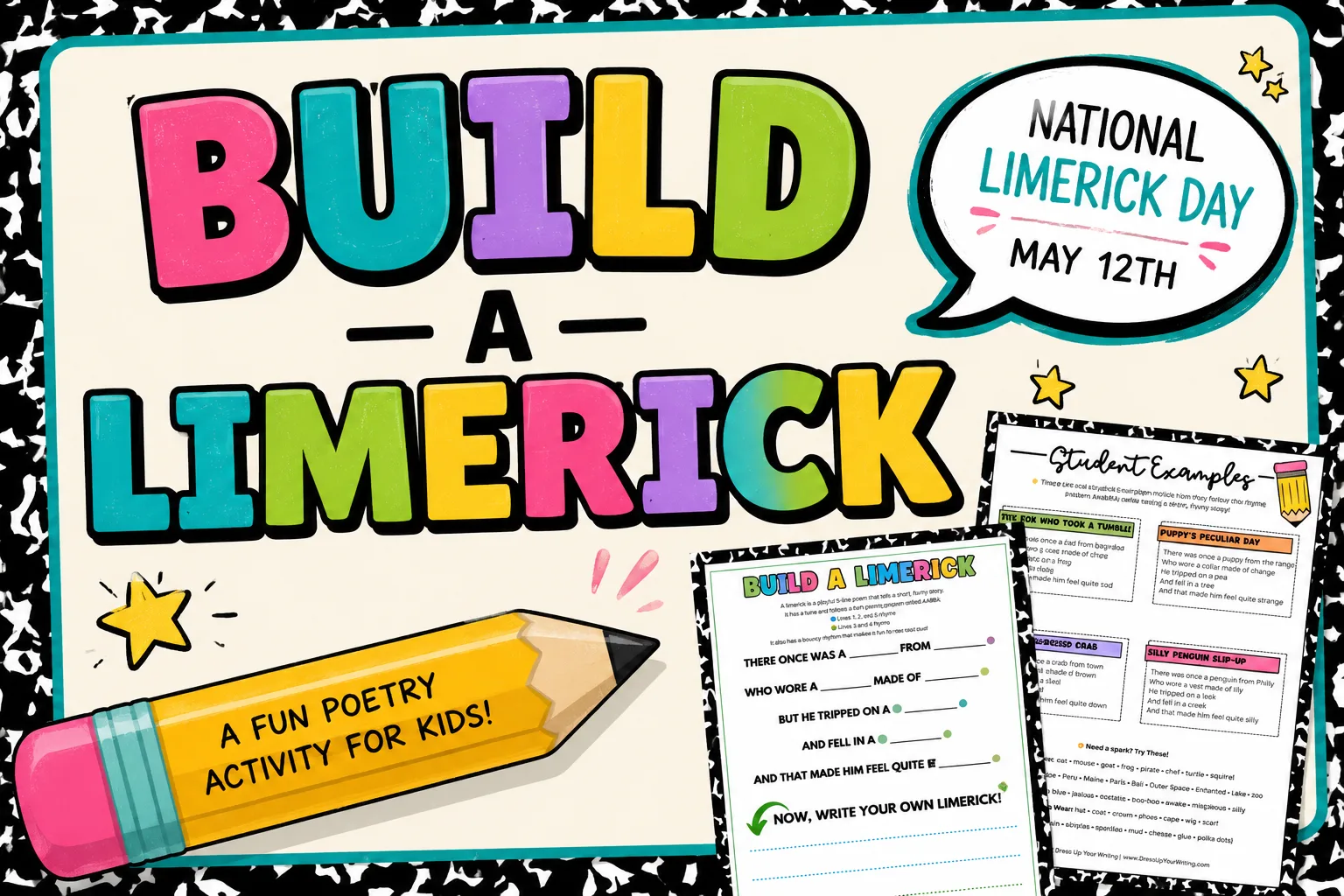
Build a Limerick: A Fun Poetry Activity for Kids
✏️ Silly Rhymes That Spark Big Writing Fun
National Limerick Day (May 12th) is a wonderful excuse to celebrate poetry, but this activity can be enjoyed all year long!
Limericks are short, silly, and just structured enough to feel like a game. Even reluctant writers tend to lean in when there’s humor, rhyme, and a little bit of nonsense involved.
And the best part?
They naturally build vocabulary, rhythm, and creativity without feeling like a formal lesson.
Let’s jump in!
✏️ Writing Prompt
Try writing your own limerick about something unexpected or funny:
- A mischievous animal
- A student who can’t stop sneezing
- A teacher with a secret talent
- A very unlucky day
You can also spark ideas with a simple starter:
👉 There once was a ______ from ______…
Encourage students to make it silly, surprising, or even a little ridiculous. That’s part of the charm!
🤖 What Is a Limerick? (Quick & Kid-Friendly)
A limerick is a 5-line poem with a very specific rhythm and rhyme pattern:
- Line 1, 2, and 5 rhyme (A)
- Line 3 and 4 rhyme (B)
- The pattern looks like this: AABBA
It usually has a bouncy rhythm and tells a tiny, funny story.
Here’s a simple example:
There once was a cat who wore shoes (A)
Who danced to the loudest of blues (A)
He slipped on a mat (B)
Then sat with a splat (B)
And said, “Well, that’s one way to lose!” (A)
🎲 Make It a Game
Turn limerick writing into a playful activity:
Option 1: Pass the Poem
- One student writes line 1
- Pass it to the next student for line 2
- Continue until all 5 lines are complete
- Read the final result aloud (expect laughter!)
Option 2: Rhyme Challenge
- Give students a word like cat, tree, or day
- They must build a limerick around it
Option 3: Fill-in-the-Funny
- Provide a partially written limerick and let students complete it
📚 Book Pick
For inspiration, explore the whimsical world of
📖 There Was an Old Man in a Tree: Edward Lear’s Nonsense Rhymes Revised for New Times
Lear is widely considered the father of the limerick, and his poems are delightfully absurd—perfect for showing students that writing doesn’t always have to make perfect sense to be enjoyable.
🎉 Family Fun Idea
Host a Limerick Laugh-Off!
- Each family member writes a limerick
- Take turns reading them aloud dramatically
- Vote on categories like:
- Funniest
- Most creative
- Silliest ending
Optional: Record your readings and turn it into a mini “poetry night” to share with friends or grandparents.
🖨️ Free Printable: Write Your Own Limerick
To make this even easier (and more fun!), grab your free printable:
✔️ A fill-in-the-blank guided limerick to get started
✔️ Space to write your own original poem
✔️ A page of real student examples for inspiration
✔️ A helpful word bank (perfect for when you need a spark!)
This is perfect for:
- Homeschool lessons
- Co-op activities
- Quick writing warm-ups
- Poetry units
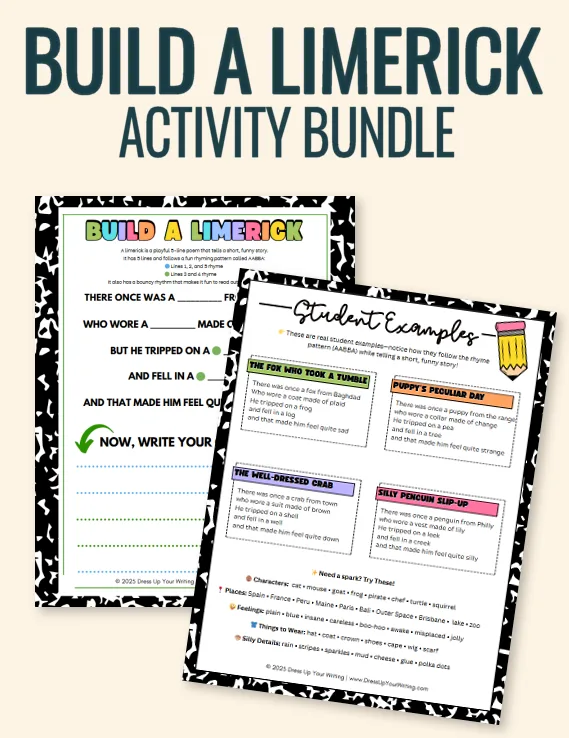
👉 [Download the Build a Limerick Bundle here]
✨ Why Limericks Matter
Limericks may be lighthearted, but they’re doing important work:
- Building phonemic awareness through rhyme
- Strengthening sentence structure and rhythm
- Encouraging word play and creativity
- Helping reluctant writers feel successful quickly
Most importantly, they remind students that writing can be fun.
And sometimes, that’s exactly what sparks a lifelong love of words.
💬 Let’s Keep the Fun Going!
If you loved this activity, don’t stop here!
We’ve created a full collection of National Days writing prompts to help you bring a little creativity (and a lot of fun) into your writing time all year long.