

πŸŽ‰ National Days Library Books β€’ Writing β€’ Family Fun Explore all days β†’

Fibonacci Day

Learning Adventure

Celebrate a fascinating number pattern hiding in math, history, poetry, and the natural world.

Curated by Laela
fibonacci day
Find the Pattern!
πŸ“Œ Quick FactsπŸ“… November 23🌍 Celebrated Worldwide πŸ”’ 11/23 begins 1, 1, 2, 3!
❀️ Why We Celebrate

Every November 23, Fibonacci Day celebrates one of mathematics' most famous number patterns. Written as 11/23, the date itself begins the sequence 1, 1, 2, 3, where each new number is found by adding the two numbers before it.

πŸ’‘ Did You Know?

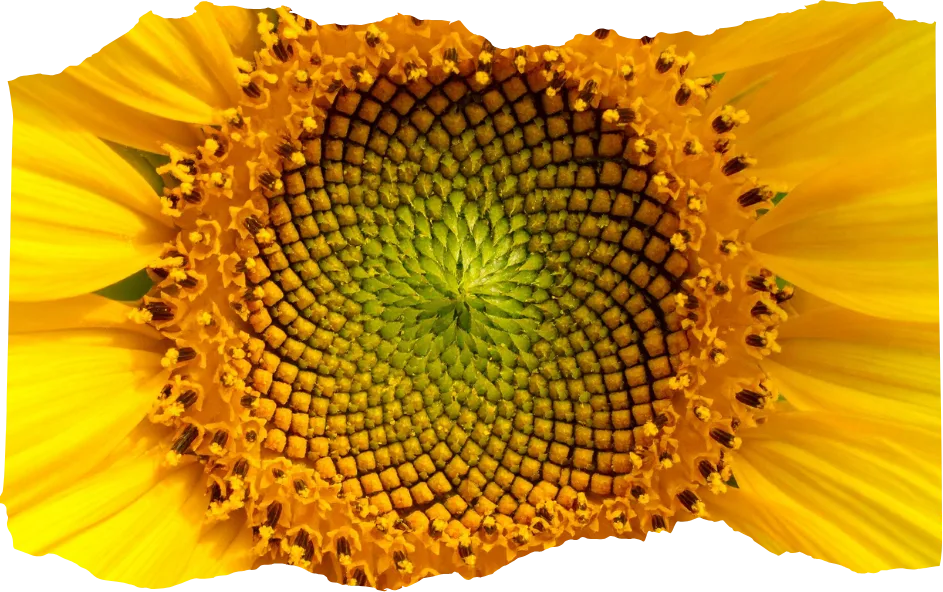
🌻 If you count the spirals in a sunflower's seed pattern, the totals often turn out to be Fibonacci numbers such as 21, 34, or 55!

✨ Adventure Highlights
πŸ“ Fibonacci Poetry πŸ”’ Number Patterns 🌻 Patterns in Nature β…« Roman Numerals
ο»Ώ
1

Read

πŸ“–

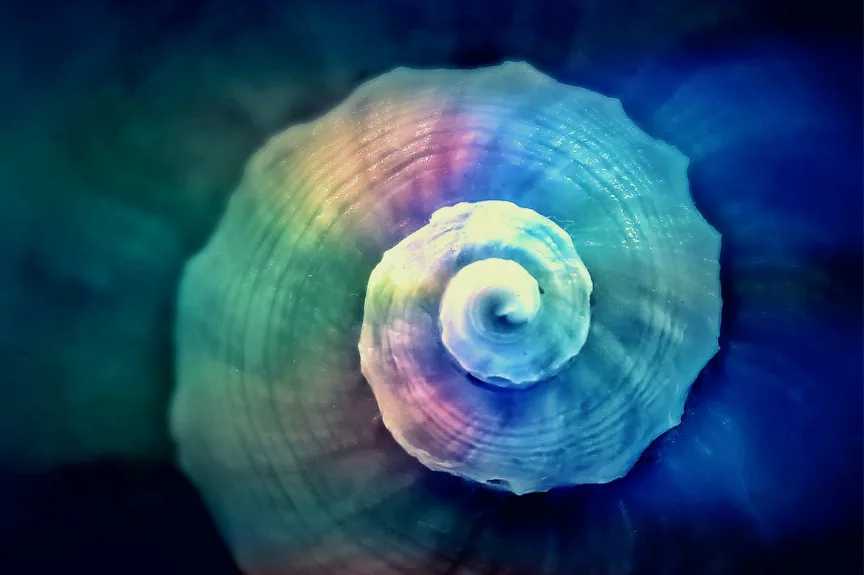
Patterns in Nature: Why the Natural World Looks the Way It Does

by Philip Ball

Why do seashells spiral, tree branches divide, and zebras wear stripes?

Filled with incredible photographs, Patterns in Nature invites families to look more closely at the shapes and designs appearing throughout the natural world. Browse the photographs together and see how many kinds of patterns you can spot… from spirals and symmetry to branching, fractals, spots, and stripes.
πŸ“– View Book
2

Write

✏️
Can a poem grow like a number pattern?Create a six-line poem in which the number of words in each line follows the Fibonacci sequence:(1 β€’ 1 β€’ 2 β€’ 3 β€’ 5 β€’ 8)Your poem can be about nature, numbers, something you notice outside... or anything else you choose!

Example

Numbers
grow
one step
at a time
each new line reaching farther

Need a Little Inspiration?

Start with one small word and let your idea grow. You might begin with Sun, Rain, Stars, Leaves, Light, or even Math. Count the words in each line as you go: 1, 1, 2, 3, 5, 8.

Want another challenge? After reaching eight words, try shrinking your poem again: 5 β€’ 3 β€’ 2 β€’ 1 β€’ 1.

3

Family Fun

πŸŽ‰
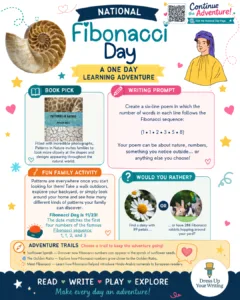
spiral pattern

Go on a Pattern Hunt

Patterns are everywhere once you start looking for them!

Take a walk outdoors, explore your backyard, or simply look around your home and see how many different kinds of patterns your family can discover.

Look for:

  • πŸŒ€ Spirals
  • πŸͺž Symmetry
  • 🌳 Branching
  • πŸ” Repeating patterns
  • 🌼 Shapes radiating from a center

If you have a sunflower, pinecone, pineapple, flower, or other interesting natural object nearby, examine it closely. What patterns can you see that you might normally overlook?

Bonus Math Puzzle

Ready to keep the numbers going?

Try the Professor Polygon math puzzle featuring a Fibonacci sequence and see if you can discover the rule before Professor Polygon gives it away!

πŸ’œ Resources We Love Β· Some links are affiliate links that support DUYW at no extra cost to you.
🌎 Keep Exploring

Every adventure has another path to follow. Choose a trail and see where your curiosity leads!

Nature Trail: Sunflower Spirals

Look closely at the center of a sunflower and you may see seeds arranged in spirals curving in two directions. The National Museum of Mathematics shows how counting those spirals can reveal Fibonacci numbers.

Wonder Challenge: Explore MoMath’s sunflower spiral. What three Fibonacci numbers can you find in their colored examples?

History Trail: Meet Fibonacci

Leonardo of Pisa (better known today as Fibonacci) grew up in a merchant family and learned mathematics while traveling around the Mediterranean. He encountered the Hindu-Arabic number system in North Africa and recognized how useful it was for calculations. In 1202, he shared these methods in his book Liber Abaci, helping European readers discover a much easier way to calculate than relying on Roman numerals.

Wonder Challenge: Try solving XII Γ— XII using Roman numerals. Then solve 12 Γ— 12. Which system is easier to use?

Math Trail: The Golden Ratio

As Fibonacci numbers grow, the relationship between neighboring numbers gets closer and closer to 1.618, a famous number called the Golden Ratio. This proportion often creates shapes and designs that feel balanced and pleasing to the eye, and similar relationships can appear in patterns in nature.

Wonder Challenge: Try 13 Γ· 8, 21 Γ· 13, and 34 Γ· 21 on a calculator. Which answer comes closest to 1.618?

Would you rather...

OR

Print & Plan

Printable Lesson Snapshot

Keep today’s book pick, writing prompt, family activity, and discussion ideas together in one colorful overview.

View & Print This Adventure Perfect for homeschool or classroom planning.

Keep Exploring