


15 Grammar Jokes That Make Students Groan (But Secretly Learn) 😄📚
Confession.
If a grammar joke makes students groan, I consider that a success.
Because somewhere between the eye roll and the reluctant smile… learning sticks.
Wordplay helps students:
- Notice patterns
- Remember definitions
- Connect abstract concepts to something concrete
- Relax
And relaxed students learn better.
Today I’m sharing classroom-friendly grammar jokes you can use as icebreakers, bell ringers, or quick brain breaks. At the end, you’ll find a free printable set of PUN-CTUATION Appreciation Notes you can use all year long.
🧠 Why Grammar Jokes Work
When students laugh at a joke like:
Past, present, and future walked into a sentence. It was tense.
They are reinforcing the concept of verb tense without feeling like they are studying it.
Humor creates mental hooks. And hooks help ideas stick.
This works beautifully for:
- Homeschool language arts
- Co-op writing classes
- Middle school grammar review
- Elementary parts of speech practice
If you’re already using tools like the Grammar Bot or the Verb Replacer Tool, this kind of playful warm-up fits perfectly before deeper analysis work.
😂 15 Grammar Jokes for the Classroom
Use these as:
- Morning warm-ups
- Writing class openers
- Brain breaks
- Test review days
- Or even National Punctuation Day or National Grammar Day activities 👀
1️⃣
Past, present, and future walked into a sentence.
It was tense.
📝 Teacher Tip:
Have students identify all three verb tenses and write one sentence in each. This pairs beautifully with our helping verbs mini lesson.
2️⃣
Why did the verb get detention?
It wouldn’t agree.
📝 Teacher Tip:
Perfect intro before reviewing subject-verb agreement!
3️⃣
I have a joke about a run-on sentence but it never seems to stop and it just keeps going and going and going and —
📝 Teacher Tip:
Ask students to fix the run-on three different ways:
- Period
- Comma + coordinating conjunction
- Semicolon
Great reinforcement for sentence structure.
4️⃣
Why did the comma break up with the sentence?
It needed space.
📝 Teacher Tip:
Use this before reviewing commas in compound sentences or items in a series. Have students write one sentence that truly needs a comma.
5️⃣
What did the adjective say to the noun?
“You complete me.”
📝 Teacher Tip:
Try pairing this with the Adjective Makeover Tool for a quick descriptive writing extension.
6️⃣
Why are fragments such bad storytellers?
They just… never finish.
📝 Teacher Tip:
Put three fragments on the board. Let students turn them into complete sentences.
7️⃣
Why did the apostrophe feel possessive?
Because it was.
📝 Teacher Tip:
Quickly review:
- Possessive noun
- Contraction
- Plural
Have students generate one example of each.
8️⃣
Why are semicolons so confident?
They know when to pause and when to connect.
📝 Teacher Tip:
Challenge students to combine two related independent clauses using a semicolon. Bonus points if they explain why a period would also work.
9️⃣
Why did the subject bring a ladder to class?
To reach the predicate.
📝 Teacher Tip:
Have students identify subject and predicate in a silly sentence, then plug it into Grammar Bot!
🔟
What dinosaur knows lots of synonyms?
A thesaurus.
📝 Teacher Tip:
Pair with our fun Synonym Buns game!
1️⃣1️⃣
Why don’t adjectives argue?
They modify their tone.
📝 Teacher Tip:
Tie this into cumulative vs. coordinate adjectives. Can students test whether commas are needed?
1️⃣2️⃣
Seven days without a pun makes one weak.
📝 Teacher Tip:
Try using this for a fun intro to homophones!
1️⃣3️⃣
Why did the nouns panic?
Because they heard they were about to be replaced by pronouns!
📝 Teacher Tip:
Have students rewrite a super repetitive paragraph by replacing nouns with pronouns correctly.
1️⃣4️⃣
Why did the clause feel independent?
Because it could stand on its own.
📝 Teacher Tip:
Write one independent clause and one dependent clause. Ask students which can stand alone and why.
1️⃣5️⃣
How do you comfort a grammar snob?
“There, their, they’re.”
📝 Teacher Tip:
Use this before a homophones mini lesson or as a quick editing challenge.
We tried to stop at 15…
But the jokes just kept going and going and going.
Clearly, we have a run-on problem.
1️⃣6️⃣
Why was the preposition always calm?
It knew its place.
📝 Teacher Tip:
Have students write a sentence with a prepositional phrase and underline it.
1️⃣7️⃣
Why did the helping verb feel important?
Because it was supporting the main act.
📝 Teacher Tip:
Ask students to identify the helping verb in three example sentences.
1️⃣8️⃣
Why did the simile blush?
It was as red as a tomato.
📝 Teacher Tip:
Have students write one original simile and share it aloud. Check out Simile Monsters for more fun!
1️⃣9️⃣
I’m so tired I could sleep for a thousand years.
📝 Teacher Tip:
Ask students to identify whether it’s hyperbole or literal language. Then have them write their own exaggerated sentence. Check out the Great Hyperbole Pair-Up while you’re at it!
2️⃣0️⃣
Why did the word go to the gym?
To build strong sentences.
📝 Teacher Tip:
Visit the Word Spark Tool and challenge students to write one powerful sentence using today’s word!
✏️ Turn These Into Mini Lessons
Want to stretch this into something more than a quick laugh?
Try one of these:
- Ask students to identify the grammar concept in the joke.
- Have them explain why it is funny.
- Challenge them to rewrite the joke more clearly.
- Host a “Grammar Groan-Off” where students compete to create the best pun.
If you’re looking for more playful grammar warm-ups, you might also enjoy:
🎁 Free Download: Lunchbox Laughs: Grammar Edition
If your students love wordplay, this free printable is for you.
I created a set of Lunchbox Notes (Grammar Edition!) that you can:
- Slip into folders
- Use as lunchbox notes
- Hand out before a grammar test
- Encourage a reluctant writer
- Keep in your co-op supply bin
Inside you’ll find cheerful notes like:
- You’re EXCLAMATION-POINT AMAZING!
- Without you, I’m just a fragment.
- You’re my main clause.
- You complete my sentence.
- We make a great pair, like subject and predicate.
They reinforce grammar vocabulary in a light, encouraging way.
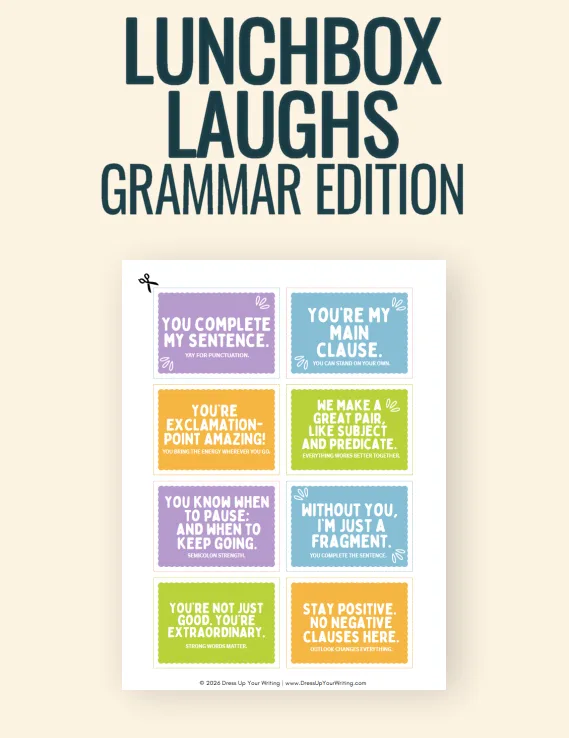
👉 Click here to download the Lunchbox Laughs: Grammar Edition freebie.
💛 Make Grammar Memorable
Grammar does not have to feel heavy.
It can feel clever.
It can feel creative.
It can even feel joyful.
Sometimes all it takes is one terrible pun to make a concept stick for years!
If you try one of these in your homeschool or co-op, I would love to know which joke caused the biggest groan. 😉