

Why Prepositions Are Hard (and How to Make Teaching Prepositions Fun & Easy!)
Prepositions might seem like simple little words, but for many kids, they can be surprisingly tricky to master. Whether you’re a parent, teacher, or homeschooler, chances are you’ve noticed prepositions tend to trip kids up more than expected.
One quick way to make them less intimidating is to look at the word itself: prePOSITION. Inside it, you can spot the word position—and that’s a great reminder that most prepositions show a position in space or time.
Let’s explore why prepositions are so hard to learn—and how you can teach them in fun, hands-on ways that actually stick.
Table of Contents
🤔 Why Are Prepositions So Tricky?
🌀 1. They’re Abstract
Prepositions describe relationships—often between objects in space or time—but those relationships aren’t always easy to visualize. Unlike nouns or verbs, prepositions rely heavily on context and perspective.
🔁 2. They Often Have Overlapping Meanings
Take on vs. in vs. at. You can be on the bus, in the car, and at the airport—and kids are just supposed to memorize which is which? No wonder they get confused!
🧩 3. They Depend on Usage, Not Logic
Many prepositions appear in idiomatic phrases:
- on purpose
- under pressure
- by accident
These don’t always follow literal placement rules, making them harder to decode.
📉 4. They’re Often Overused or Misused
Young writers tend to rely on a small set of prepositions (in, on, at) and avoid more descriptive ones (beneath, beside, beyond) simply because they haven’t had enough exposure.
🎉 Teaching Prepositions with Fun!
Here are ten engaging, movement-based, and creative ways to make prepositions click:
🧗♀️ 1. Preposition Obstacle Course
Create a course using pillows, chairs, or outdoor objects.
Kids crawl under the table, jump over a rope, tiptoe between cushions—and say the preposition out loud as they go!
🔎 2. Preposition Scavenger Hunt
Give kids clues that use prepositions:
“Find something behind the curtain.”
“Place a toy in the box.”
This builds both comprehension and application.
🧸 3. Stuffed Animal Preposition Show
Have kids move a stuffed animal on the couch, beneath the blanket, or beside a pillow.
Add sticky notes with the prepositions for reinforcement.
🎨 4. Draw It! Preposition Prompts
Draw silly scenes based on card prompts like:
“Draw a squirrel dancing on a sandwich.”
This builds spatial awareness through art.
📚 5. Preposition Picture Books
Read books with strong visual support for prepositions, such as:
- Rosie’s Walk by Pat Hutchins
- Under, Over, By the Clover by Brian P. Cleary
Let kids point out or act out the prepositions as you go.
🃏 6. Preposition Card Game
Use our printable game pack of Character Nouns, Verbs, Prepositions, and Object Nouns to build silly, grammatically correct sentences like:
“The squirrel sneezes under the trampoline.”
Then draw or act them out!
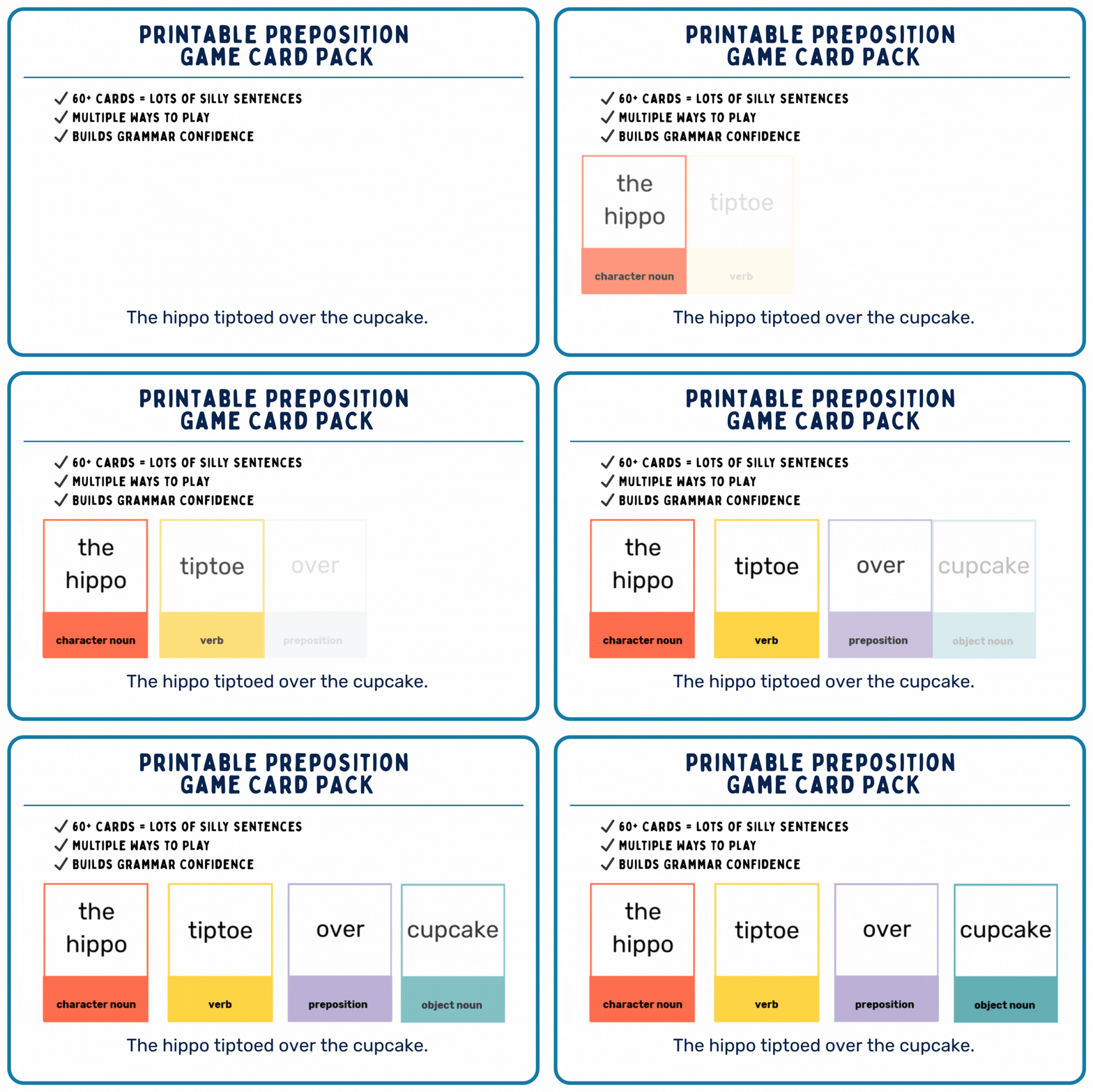
This free preposition card game includes:
- 16 Character Nouns
- 16 Object Nouns
- 16 Verbs
- 16 Prepositions
- 2 blank cards per category so kids can add their own!
You can use the same deck to play silly grammar games, act out scenes, or create drawing prompts.
🎁 Download the free printable here →
🕵️♂️ 7. “Where Is It?” Mystery Writing
Have kids write or dictate clues using prepositions:
You won’t find me on the floor, and I’m not hiding inside a drawer.
I stand tall with a stack of friends just like me.
You pull me out by my spine, then flip through my pages.
I’m resting quietly on a shelf.
What am I?🧠 Answer: A book!
🏰 8. Miniature World Prepositions
Use toys, blocks, building pieces, or a dollhouse to model:
“The knight hides behind the castle.”
“The puppy jumps into the box.”
🧱 9. Interactive Preposition Word Wall
Group prepositions by category (location, direction, time) and add illustrated sentence examples. Let kids help add their own as they learn new ones!
✍️ 10. Preposition Poetry
Try a simple poem format like:
Above the trees,
Beneath the stars,
Between two dreams,
That’s where you are.
Encourages expressive use of language while reinforcing prepositions.
🧠 Teaching Prepositional Phrases: What They Are & Why They Matter
A prepositional phrase includes:
- the preposition
- and the object of the preposition (usually a noun or pronoun)
✅ Example: under the trampoline
- “under” = the preposition
- “the trampoline” = the object
Together, this phrase answers where?, when?, or which one?
🧭 Why Teaching the Whole Prepositional Phrase Helps Students
When students only identify the preposition, they may misunderstand the sentence’s meaning or structure. Teaching them to follow the phrase all the way through to the noun helps with:
- Sentence diagramming
- Subject-verb agreement (especially when the phrase comes between them!)
- Writing stronger, more descriptive sentences
❗ Example:
The cat [under the couch] is sleeping.
The subject is cat, not couch!
🧰 How to Teach Prepositional Phrases to Upper Elementary & Middle School
🔍 1. Highlight the Whole Phrase
Give students short sentences and ask them to highlight the entire prepositional phrase—not just the preposition.
The knight jumped over the wall.
The pizza on the table is mine.
Use color coding or brackets for emphasis.
🧱 2. Stack-the-Phrase Challenge
Use sentence-building blocks:
- Start with a simple sentence
- Add a prepositional phrase
- Try moving it around for effect!
The squirrel danced.
→ The squirrel danced on the trampoline.
→ On the trampoline, the squirrel danced.
Great way to show sentence variety!
📝 3. Phrase Sorting
Give students a mix of:
- Prepositions
- Nouns
- Complete prepositional phrases
Have them sort into three categories and match prepositions with logical objects.
🎯 4. Object-Finding Game
Show a sentence with a prepositional phrase and ask:
“What is the object of the preposition?”
Example: She tiptoed past the cat.
👉 Object = cat
This reinforces the idea that prepositions always lead to a noun or pronoun.
🧠 5. Phrase vs. Clause Mini-Lesson
Older students often confuse phrases and clauses. A quick rule of thumb:
- Prepositional phrase = no subject or verb
- Clause = includes a subject and verb
Here’s a clear way to show the difference using the same sentence:
The squirrel danced under the trampoline because it was raining.
🔹 Prepositional Phrase: under the trampoline
- Preposition = under
- Object of the preposition = trampoline
- ✅ No subject or verb
- ✅ Can’t stand alone
- ➡️ Answers where?
🔸 Clause: because it was raining
- Contains a subject (it) and a verb (was)
- ✅ This is a dependent clause (also called a subordinate clause)
- ➡️ Explains why something happened

Preposition or Adverb? This One Trips Everyone Up
You’ve introduced prepositional phrases. You’ve diagrammed “under the table” and “through the tunnel.” You’re feeling good. Then your student says, “But I thought above was an adverb?” Don’t worry—it’s a totally reasonable mix-up. And it opens the door to some great real-life grammar thinking. Let’s look at this sentence from our own classroom:
The big red balloon floated above us.
Our student guessed that “above” was an adverb because it seemed to tell how the balloon floated.
That’s a great guess—but here’s the trick!
If the word is followed by a noun or pronoun (like us), it’s acting as a preposition.
Prepositions show relationship, often in terms of location, direction, or time. In this case, “above” connects the balloon to “us.”
💡 Student Tip: Adverbs can answer how, when, or where, but not all where-words are adverbs. Prepositions love partners — if there’s a noun after it, it’s probably a preposition.
🧠 Teaching Abstract Prepositions (of, with, by, and more)
While younger learners benefit from acting out under the couch and drawing above the cupcake, older students need to go further—especially when they start encountering more abstract prepositions in reading and writing.
These are words like of, with, to, by, and for—prepositions that don’t describe location, but instead show relationships like possession, manner, or cause.
For example:
📚 The book of fairy tales sat quietly on the shelf.
🧵 The cape was sewn by my grandma.
💌 She sent a letter to her friend.
To help older students grasp these, try teaching what the preposition is doing in each sentence. Is it showing who owns something (of), how something was done (with), or who did the action (by)?
We’ve created a printable Abstract Prepositions Mini-Lesson + Practice Sheet that breaks this down into clear categories, with examples like:
✅ Possession (of, from)
✅ Manner (with, in, by)
✅ Cause (because of, for)
✅ Agent (by)
✅ Association (with, about, for)
✅ Direction or Recipient (to)
👉 Click here to download the abstract prepositions mini lesson
📦 Want to Make It Even Easier?
We’ve created a printable Preposition Card Game + Draw It! Prompt Set you can use at home or in the classroom.
It includes:
- 16 Character Nouns
- 16 Object Nouns
- 16 Verbs
- 16 Prepositions
- 2 blank cards per category so kids can add their own!
You can use the same deck to play silly grammar games, act out scenes, or create drawing prompts.
🎁 Download the free printable here →
✅ Final Thoughts on Teaching Prepositions
Prepositions might be small, but they carry a lot of meaning—and a lot of confusion. The good news? You don’t have to teach them with grammar drills.
With a few hands-on tools and a little imagination, your kids will be tiptoeing around the couch and dancing beneath the stars in no time.